Determining Envelope Hole Size: ELA vs. EfLA vs. EqLA
April 13, 2023
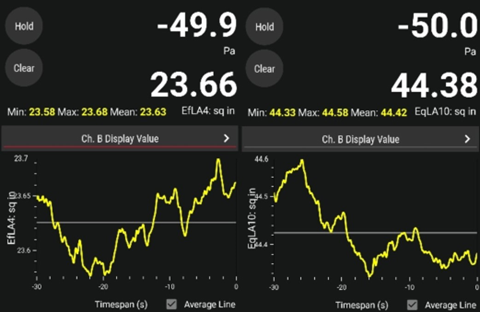
One great feature of the DM32 and DM32X digital gauges is the ability to show the total hole size if all of the holes, cracks, and gaps in the building envelope were added up into one large hole. But there are several options for this. The most common that are often discussed in the building science and HVAC industries are effective leakage area (ELA) and equivalent leakage area (EqLA). So, what is the difference between the two? Which one is correct?

To provide the best possible answer, we reached out to Colin Genge, founder of Retrotec. Below is a detailed explanation of the two methods along with some history on how certain air tightness metrics came to be.
So, which is better? ELA or EqLA? Below is what Colin had to say.
The short answer: ELA (from now on referred to as EfLA) isn’t useful to technicians and most blower door testers. EqLA10 is the setting on your DM32/DM32X to best estimate hole size in a building envelope.
The long answer: To begin with, EfLA is based on an induced building pressure of 4 Pa. Back before the days of the 50 Pa target pressure for testing homes, 4 Pa was used to measure the hole size in a building envelope under natural conditions. Four Pascals is the average mass flow weighted pressure the American house is under during a heating season (we realize this is a bold attempt to package homes together under one average in a country with various climate zones, but this is what we had to work with back then). This is useful to determine the total airflow lost during the season. By “mass flow weighted,” we mean that many days will have average pressures across the envelope of much less than 4 Pa. However, fewer days at a higher pressure such as 6 Pa is worth a lot of days at 1 Pa when total losses are considered.
The flow equations for EfLA and EqLA are based on two different models. EfLA is based on air flow through an elliptical nozzle-shaped hole that would leak the same amount of air as the building does at a pressure of 4 Pa with reference to the outdoors. EqLA assumes the air is flowing through a hole in a thin panel that would leak the same amount of air as a building does at a pressure of 10 Pa with reference to the outdoors.

For EqLA, the discharge coefficient is 0.611. This means the flow past a sharp edge will contract to 0.611 times the apparent open hole. The “thin panel“ aspect is important here. Equally important is the existence of a sharp edge to cause the air to break away cleanly from the hole. This accurately defines the diameter of the hole. If the hole has any rounding at all, the equivalent leakage area hole size is somewhere in the middle of that rounded surface.

The EfLA airflow equation can be used without assuming a discharge coefficient. This formula was established in the late 70s when LBL was fixated on calculations of energy loss over a season. This classic flow derivation would assume a fully contracted flow path. Back then, we all used flow nozzles to measure airflow, so we may have decided to equate the house flow to nozzle flow so we would have a balanced equation. Researchers in Canada came along a year or so later and decided:
- 4 Pa was too low a test pressure even when extrapolating. 10 Pa would provide better repeatability, which was correct but still problematic because of instability.
- Being able to visualize and reproduce the hole was important. Some test chambers and even test fans were beginning to use holes in flat plates to both measure flow and help visualize it.
The Canadians then developed depicting results in EqLA at 10 Pa with the 0.611 discharge coefficient while the US still provided EfLA results at 4 Pa with a 1.0 discharge coefficient. This makes it smaller by a factor of 0.611 even if the slope is 0.5 or the square root from the classic derivation formula. This all started to get confusing as results began to be expressed in ACH50 which is what the Swedes used. This later turned into CFM50 in the US. Canada used both, which added to the confusion.
Even though EfLA is not useful to field technicians, both models have their place for certain applications. It depends on if you want to repeatedly classify airtightness into categories or calculate energy loss under ambient conditions. We have evolved more to the former, which is why we now use CFM50. EqLA10 is a good visualization tool, but that is about it.
So, the conclusion would be that EfLA is buried classic in energy loss formulas that are no longer used today and EqLA is a nice representational tool to visualize how big the hole is. It is worth mentioning that in some scientific literature, both EfLA and EqLA have been called ELA, leaving it up to the reader to figure out which one of the two was being referred to. It was Retrotec that consistently put the q or f in the nomenclature to differentiate between the two to avoid confusion.
So why does Retrotec include EfLA at all? The main reason is to keep our manometers versatile. We understand our equipment is used for many different purposes, both in the field and in scientific laboratory settings. Not only do we include EfLA4 and EqLA10, but you can use either method to reference whatever pressure you want. This way, our customers and industry partners can explore and identify new ways to visualize air leakage.