Attics, Crawl Spaces, and Basements: Infiltration Volume and Measurement Options
July 07, 2025
Establishing the Infiltration Volume (ANSI/RESNET/ICC 380-2022)
Under the ANSI/RESNET/ICC 380-2022 standard, the inclusion of attics, crawlspaces, and basements in the Infiltration Volume (IV) during blower door testing is determined by their physical characteristics and the configuration of access points during the test. This guide summarizes the criteria for inclusion or exclusion based solely on the 2022 standard.
Conditioned Space Volume (CSV) Overview
Conditioned Space Volume is the total volume of all areas within a building that are intentionally heated or cooled. This is the space that the building's HVAC system is designed to maintain at a comfortable temperature for the occupants.
Infiltration Volume (IV) Overview
The Infiltration Volume (IV) always encompasses the Conditioned Space Volume (CSV), but it also includes additional adjacent spaces that meet specific criteria. The inclusion of attics, crawlspaces, and basements depends on their construction and the status of access openings during testing.
Attics
1. Attics Not Air-Sealed and Insulated at the Roof Deck
- Excluded from IV
- Interior access doors and hatches must be closed during testing
- Exterior attic access doors, hatches, and vents should be left as-found
2. Attics Air-Sealed and Insulated at the Roof Deck
- Included in IV if attic is contiguous with and dedicated to the dwelling unit
- Interior access doors and hatches must be opened
- Exterior attic access points should be closed to the extent possible
Crawlspaces
1. Vented Crawlspaces
- Excluded from IV
- Interior access doors and hatches must be closed
- Exterior crawlspace access should be left as-found
2. Unvented Crawlspaces
- Included in IV if crawlspace is contiguous with and dedicated to the dwelling unit
- Interior access doors and hatches must be opened
- Exterior crawlspace access should be closed to the extent possible
Basements
1. Basements Below Air-Sealed and Insulated Floors
- Excluded from IV
- Interior doors must be closed
- Exterior basement access should be left as-found
2. Basements Not Below Air-Sealed and Insulated Floors
- Included in IV if basement is contiguous with and dedicated to the dwelling unit
- Interior doors must be opened
- Exterior basement access should be closed to the extent possible
Summary Table
|
Space Type |
Inclusion in IV |
Interior Access |
Exterior Access |
|
Attic (not air-sealed/insulated) |
No |
Closed |
As-found |
|
Attic (air-sealed/insulated) |
Yes |
Open |
Closed to extent possible |
|
Vented Crawlspace |
No |
Closed |
As-found |
|
Unvented Crawlspace |
Yes |
Open |
Closed to extent possible |
|
Basement (sealed/insulated floor above) |
No |
Closed |
As-found |
|
Basement (not sealed/insulated above) |
Yes |
Open |
Closed to extent possible |
Pressure Uniformity Testing for Attics, Crawl Spaces, and Basements (ANSI/RESNET/ICC 380-2022)
Purpose
This guide shows testers how to determine if attached zones (attics, crawl spaces, and basements) meet the pressure uniformity criteria set by ANSI/RESNET/ICC 380-2022 to be included in the infiltration volume. Specifically, it helps verify whether the pressure difference between these spaces and the main conditioned area during a blower door test is within 10% of the test pressure (i.e., ≤ 5 Pa if testing at 50 Pa).
Equipment Required
· Primary Manometer (connected to the blower door system)
· Second Manometer (for remote pressure readings)
· Static pressure probes or tubing (long enough to reach the test zone)
· Blower door system, properly set up in an exterior door
Preparation Steps
· - Identify Attached Zones: Attic (sealed/conditioned or unvented), Crawl space (unvented), Basement (included based on insulation and air sealing)
· - Decide inclusion in Infiltration Volume: These zones must be included if you plan to test pressure uniformity. Open interior doors/hatches per ANSI/RESNET 380 protocol.
· - Insert pressure probes/tubing: Run one end of the second manometer’s tubing into the center of the zone to be tested (e.g., attic). Ensure no kinks or crimps in the tubing. Place tubing away from direct airflow to avoid wind-induced errors.
Testing Procedure
1. Run the Blower Door Test
Set the blower door to depressurize (or pressurize) the building to a 50 Pa ΔP (or your desired test pressure). Wait until the system stabilizes.
2. Measure Zone-to-Zone Pressure
Set the + port (blue) to the pressure probe in the attached zone (attic, crawl, or basement). Read the pressure difference: this is the Zone-to-House ΔP.
3. Evaluate Pressure Uniformity
Compare the measured difference to the test pressure:
- If |ΔP| ≤ 10% of test pressure (i.e., 5 Pa if testing to 50 Pa), the zone is uniform and can be considered part of the infiltration volume.
- If |ΔP| > 10%, the zone is not pressure-neutral and must be excluded.
Repeat this process for each zone (attic, crawl space, basement) under consideration.
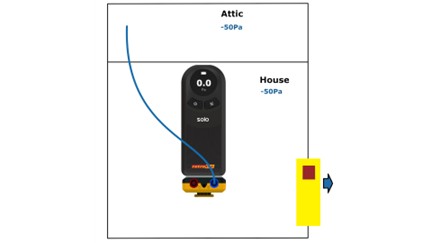
Encapsulated attic that can be applied to the infiltration volume without additional fans.
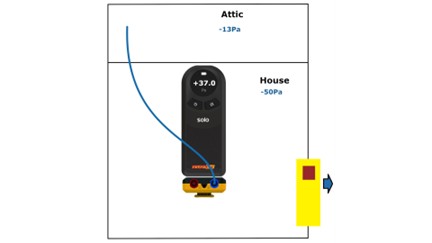
Encapsulated attic that cannot be applied to the infiltration volume without additional fans.
Documentation & Compliance
Record the following in your airtightness testing report or inspection form:
- Test pressure (typically 50 Pa)
- Pressure difference from each zone to the conditioned space
- Whether each zone met the 10% rule
- Inclusion/exclusion status of each zone in the final infiltration volume
Tips & Best Practices
· - Use the Retrotec Multi Probe or Mini Probe for zone access when there are no available hatches or openings between the zone and conditioned space.
· - The Retrotec Solo single-channel manometer is a great option for a secondary manometer for pressure uniformity checks.
· - Keep a long length of tubing with your gear to use for pressure uniformity checks when interior hatches are available.
Using a Secondary Fan to Neutralize an Additional Zone with the Conditioned Space Volume (ANSI/RESNET/ICC 380-2022)
If you find that a zone is outside of the ≤ 10% allowable ΔP and you still want to include it in the infiltration volume, a second fan will be needed to neutralize the zone with the conditioned space volume to bring it into compliance. This document outlines procedures for blower door testing of additional zones (attics, crawl spaces, and basements) using a DucTester or an additional blower door fan with the Leakage Split Kit, in compliance with the ANSI/RESNET/ICC 380-2022 standard.
Zones with Accesses Connected to the Conditioned Space Volume
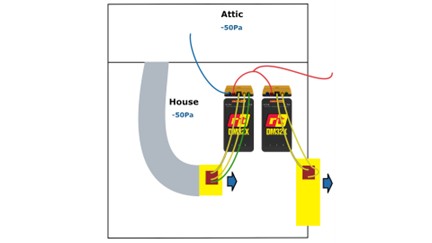
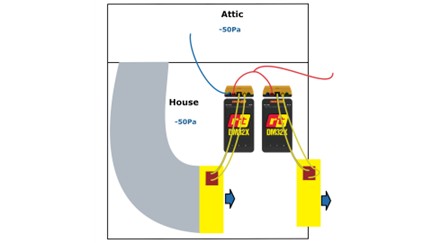
If you install the secondary fan in a hatch or opening that connects the zone to the conditioned space, you do not need to add the flow of that fan to the flow of the primary blower door installed in the exterior door. That flow will be automatically included in the reading of the primary fan.
Flow of secondary fan will not be added to the flow of the primary fan.
When setting up the tubing, connect a tube from the additional zone being neutralized to the blue port of the manometer reading the secondary fan. The exterior reference tubing will be manifolded with a tee so that the red ports both manometers are referencing the outdoors.
Software for Running a Multi-Point Test
Since two fans and manometers are needed for this multi-zone test, Retrotec’s FanTestic software will be necessary to conduct a multizone test. For more information on multipoint testing with software, please refer to the FanTestic manual for ASTM standards which can be found on Retrotec’s website. You can also find tutorial videos and recorded webinars for large building testing that covers FanTestic on Retrotec’s YouTube channel, RetrotecEnergy.
Individual Control
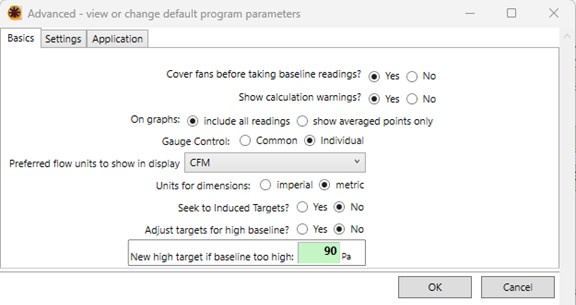
Be sure to set up the test in Individual Control. This allows FanTestic to control multiple fans at different speeds to reach the same pressure. This control option is needed for multi-zone tests. To turn on Individual Control, go to the Settings menu at the top left of the screen, then choose Advanced Settings. There will be two gauge control options: Common and Individual. Make sure Individual is selected.
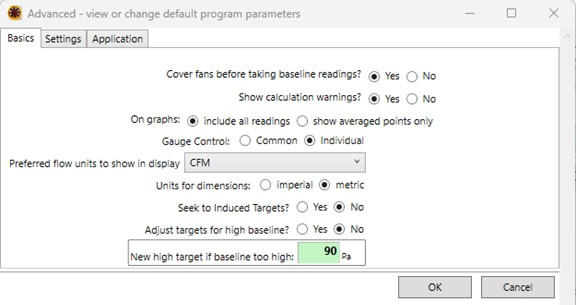
Neutralizer Fan
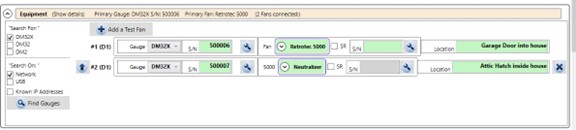
Since the flow of the secondary fan will not be collected, set that fan to Neutralizer in the Equipment section of FanTestic. This will allow FanTestic to control the gauge and fan to seek target pressures throughout the test without adding the fan’s flow to the test results.
Zones with Accesses Connected to the Outdoors
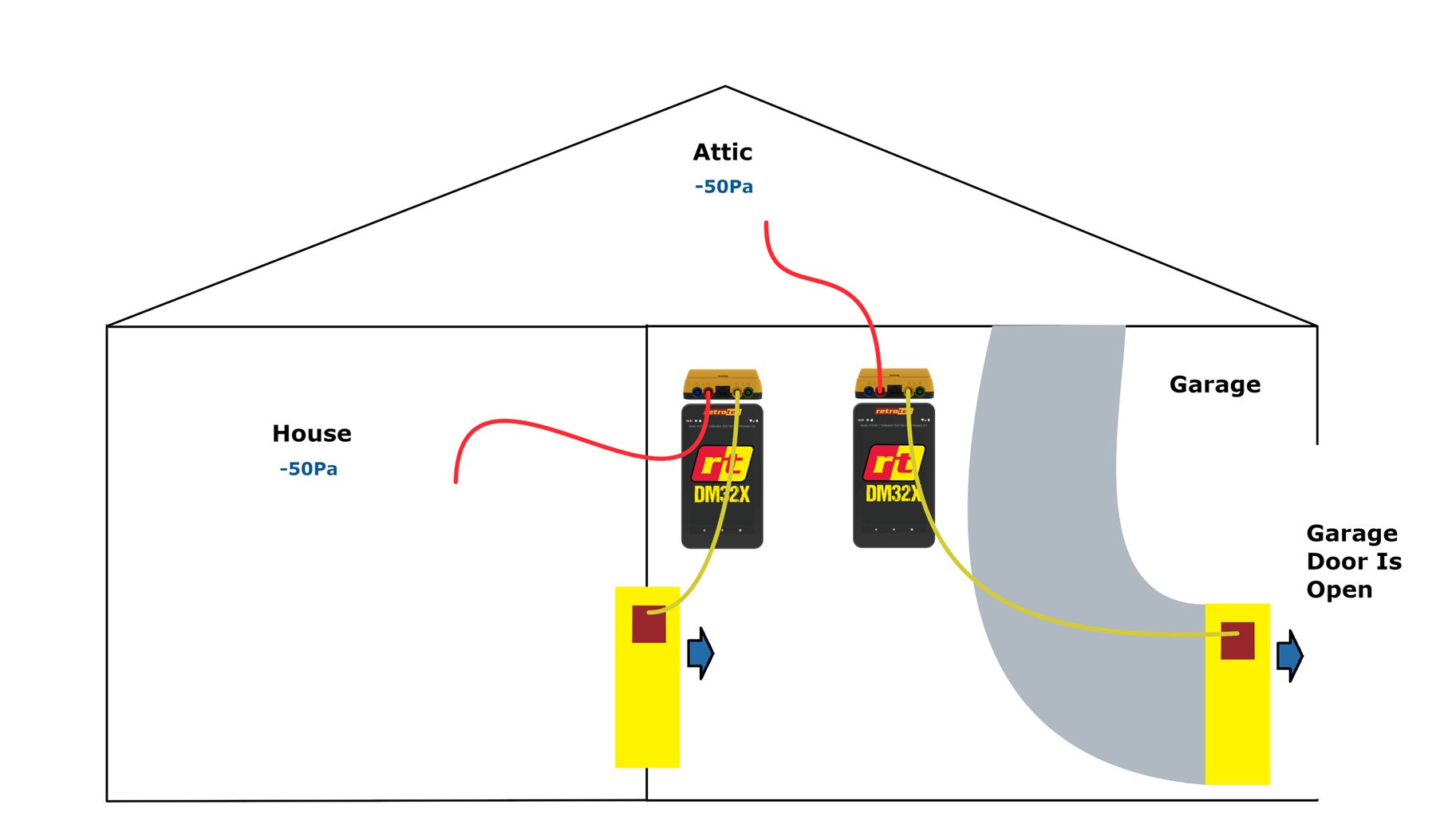
If you install the secondary fan in a hatch or opening that connects the zone to the outdoors, garage, or other area outside of the conditioned space volume, you will add the flow of that fan to the flow of the primary blower door installed in the exterior door.
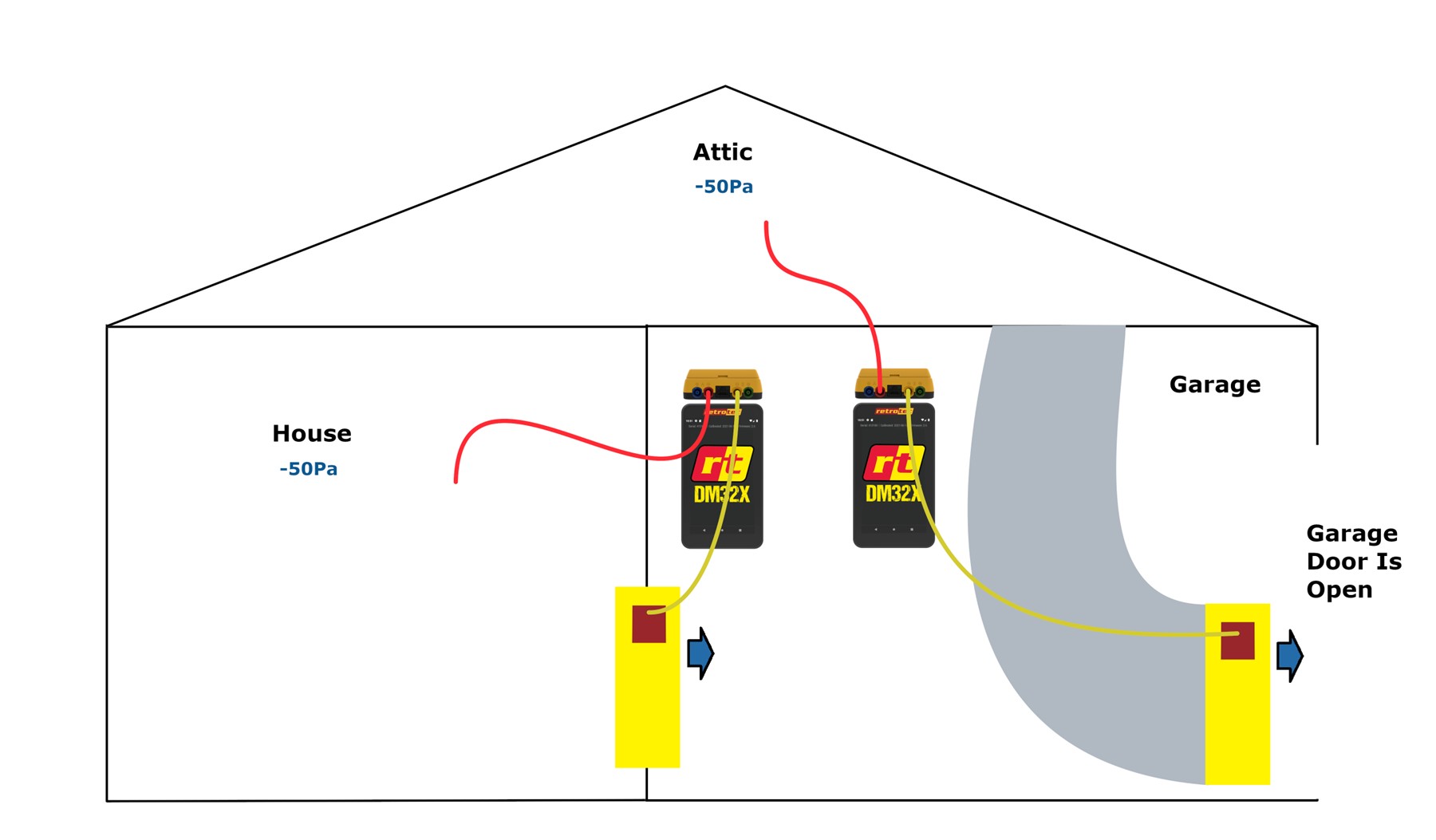
Flow of secondary fan will be added to the flow of the primary fan.
When setting up the equipment, it will be easiest to place gauges outside of the conditioned space volume. Each manometer will have a tube attached to the red port that will reference the pressure inside the zone it is connected to. There will not be a tube connected to the blue port of either, both blue ports reference outside pressure.
Software for Running a Multi-Point Test
Since two fans and manometers are needed for this multi-zone test, Retrotec’s FanTestic software will be necessary to conduct a multizone test. For more information on multipoint testing with software, please refer to the FanTestic manual for ASTM standards which can be found on Retrotec’s website. You can also find tutorial videos and recorded webinars for large building testing that covers FanTestic on Retrotec’s YouTube channel, RetrotecEnergy.
Individual Control
Be sure to set up the test in Individual Control. This allows FanTestic to control multiple fans at different speeds to reach the same pressure. This control option is needed for multi-zone tests. To turn on Individual Control, go to the Settings menu at the top left of the screen, then choose Advanced Settings. There will be two gauge control options: Common and Individual. Make sure Individual is selected.
Secondary Fan
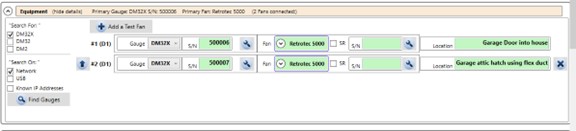
Unlike the scenario where attic accesses are connected to the conditioned space volume, when they are connected to outdoors, the flow of the secondary fan will be collected. Instead of selecting Neutralizer in the Equipment section of FanTestic, set that fan to whatever model it is. This will allow FanTestic to control the secondary gauge and fan to seek target pressures and add the fan’s flow to the test results.
Using the DucTester for Zone Neutralization
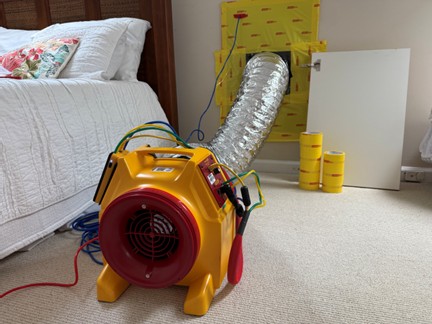
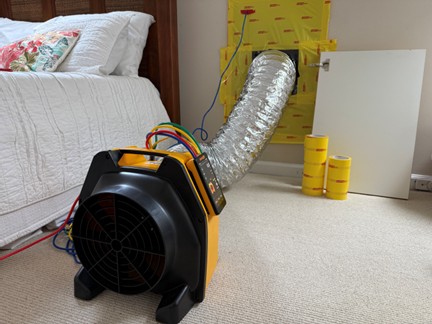
When using the DucTester as your secondary fan to neutralize a zone, tape the flange into the opening of the attic, crawl space, or basement. The location of the zone access hatch will determine how you will set up your tubing. Refer to the previous sections to see how your tubing should be connected based on the zone access location. The flex duct that comes with the DucTester kit can be attached to either size of the fan for pressurization or depressurization of the zone.
Utilizing the Leakage Split Kit for Blower Door Testing
The Retrotec Leakage Split Kit is designed to neutralize pressure differences across multiple zones during blower door testing. This ensures accurate measurement of air leakage by preventing pressure imbalances.
Components of the Kit
· - 12-foot, 24-inch diameter flexible duct
· - 2 ft x 2 ft flange for attic and crawl space openings
· - Rigid test panel for horizontal fan installation
· - Flex Duct Fill-In Sheet
· - Protective carrying case
Installation Steps
· - Remove the attic or crawl space door where the secondary blower door fan will be installed.
· - Insert the flange end of the flexible duct into the attic or crawl space opening. Use tape, the fill-in sheet, or another rigid material taped to the flange if the opening is larger than 2 ft x 2 ft.
· - Connect the other end of the duct to the secondary fan. Secure it using the provided clamp and Velcro strap.
· - Place reference tubing depending on where the zone access hatch is (connected to conditioned space volume or outdoors).
Attic Hatch Configurations and Testing Procedures
The configuration of the attic hatch significantly influences the blower door test setup.
1. Attic Hatch Connecting to Conditioned Space
- Inclusion in Infiltration Volume: If the attic is air-sealed and insulated at the roof deck, and the attic hatch opens into conditioned space, it is included in the infiltration volume.
- Interior attic access doors/hatches: Open
- Exterior attic access points: Closed to the extent possible
2. Attic Hatch Connecting to Exterior
- Exclusion from Infiltration Volume: If the attic is not air-sealed and insulated at the roof deck, and the attic hatch connects to the exterior, it is excluded from the infiltration volume.
- Interior attic access doors/hatches: Closed
- Exterior attic access points: Left in their as-found position
By following these procedures, testers can ensure compliance with the ANSI/RESNET/ICC 380-2022 standard and obtain accurate measurements of a dwelling's airtightness.
Recent Posts