
A demonstration of all testing required of HERS Raters for the new ENERGY STAR v3 Homes standard.https://youtu.be/czlCDo00Scs
Commercial Flow Pan
What it is: Pre-calibrated hood placed over exhaust registers (e.g., bathroom fans).
Why use it: Offers quick, accurate airflow readings in CFM without complex setup.
Cardboard Box Flow Pan
What it is: DIY alternative using a cardboard box and a manometer.
Upside: Inexpensive and accessible.
Downside: Less accurate—best when pre-calibrated against known standards.
Pressure-Matching via FlowFinder
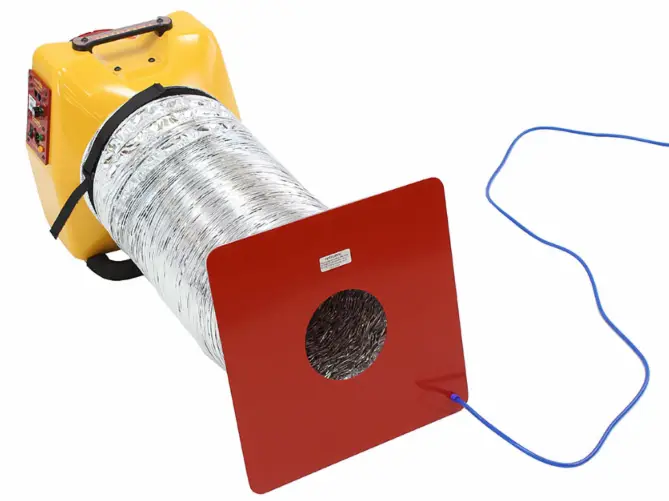
What it is: A specialized Retrotec probe that balances house pressure and fan pressure.
Ideal for: Accurate matching of ventilation airflow using static pressure techniques.
Pressure-Matching via DucTester
What it is: Uses the DucTester to pressurize the system, with measurements taken via a gauge.
Benefit: High precision for measuring ventilation flows in ducted systems.
Pitot Tube Measurement
What it is: Measures differential pressure inside a duct to calculate velocity and CFM.
Best for: Technical HVAC diagnostics where duct access is straightforward.
Small Vane Anemometer
What it is: Hand-held airspeed meter inserted into grilles.
Pros: Portable and quick.
Cons: Requires accurate grille area measurement for reliable results.
Large Vane Anemometer
What it is: Scaled-up version for larger diffusers or commercial setups.
Best use: High-velocity or large-airflow applications.
Plastic Bag Inflation Method
What it is: Measures time to inflate a plastic bag over a register.
Great for: Low-tech situations.
Note: Accuracy is variable, best for ballpark estimates.
Which Method Should You Use?
Fast & reliable: Commercial flow pan
Budget-friendly: Cardboard pan or plastic bag
Professional accuracy: Pressure-matching tools or pitot tube
Quick field checks: Vane anemometers
