
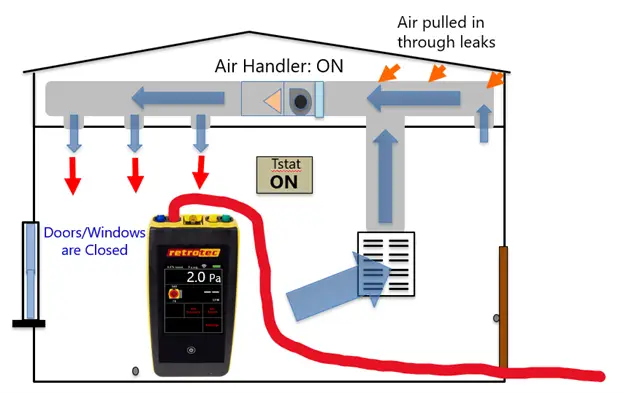
Setup Procedure
Blower Door Pressurization
The blower door is installed and used to pressurize the house to +25 Pa relative to the external environment. This establishes a baseline pressure inside the building.
Duct Tester Connection
The Retrotec DucTester is connected to the return ducting via a sealed flange and flex duct. All other supply and return registers are sealed to prevent air movement elsewhere.
Depressurizate the Duct System
With the house held at +25 Pa, the duct tester is activated to depressurize the ducts to 0 Pa relative to the house interior. This creates a 25 Pa pressure differential between inside the ducts and the outdoors.
Flow Measurement
The gauge records the airflow required to maintain this pressure—providing a reading in CFM25, which reflects the volume of air leaking from the duct system directly to the outdoors through attic, crawlspace, or wall cavity leaks.
Importance of the Test
Energy efficiency: Identifies conditioned air lost outside the thermal envelope, leading to potential energy savings.
Standards compliance: Meets ENERGY STAR thresholds (max. 4 CFM25 per 100 ft² or ≤ 40 CFM25 total)
Health & comfort: Detects leaks that could draw dust or insulation particles into the HVAC air stream.
Practical Tips
Perform a second reading: Measure both return and supply ducts, then average the two to account for system variances.
Seal thoroughly: Ensure registers, flanges, and tubing are airtight to avoid skewing results.
Test environments: Duct leakage tests are most critical when ducts are in unconditioned spaces—though hidden ducts in walls may leak outdoors as well.
