
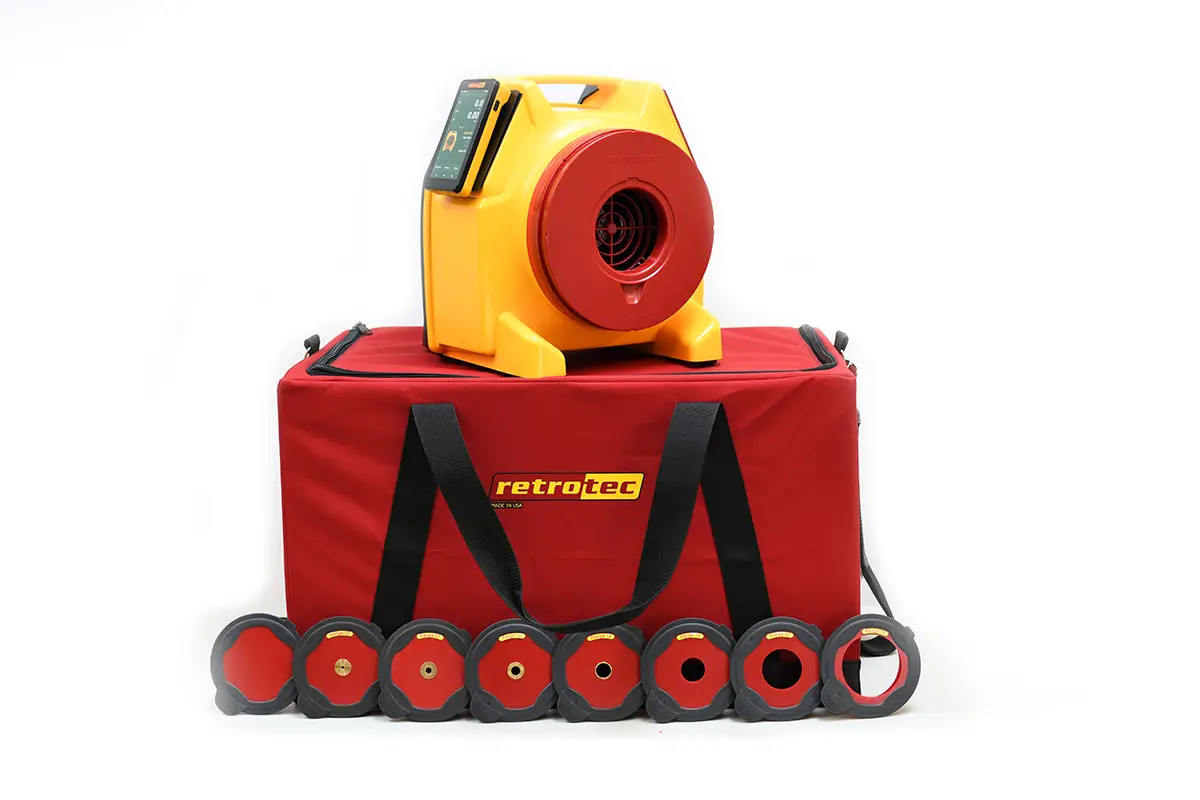
Simulated Setup Overview
A compact duct system equipped with adjustable holes, representing common leaks found in real-world HVAC systems.
All supply and return registers are sealed, except for the access point where the test fan is connected.
The fan is fitted with an adjustable range ring or plate to match the expected leakage pressure.
Testing Procedure
Connect Fan to Duct Simulator
The DucTester or similar fan is attached to the return side using a flange and flex duct.
Seal All Registers
Ensures that airflow only exits through simulated leaks, capturing total system leakage.
Depressurize the Duct System
The fan draws air out to reach –25 Pa (or another test pressure), which is the typical standard pressure for residential duct tests.
Stabilize and Record Flow
Once pressure stabilizes (roughly 30–60 seconds), gauge readings display CFM@25 Pa—a measure of total leakage from the duct system (#turn0search5).
Demonstrate Compliance vs. Leakage Control
The simulator shows how tightening (closing holes) directly lowers the CFM reading—demonstrating the test’s sensitivity to changes in duct integrity.
